
Shopify vs WooCommerce: Which Ecommerce Platform Is Best for Your Business in 2026?

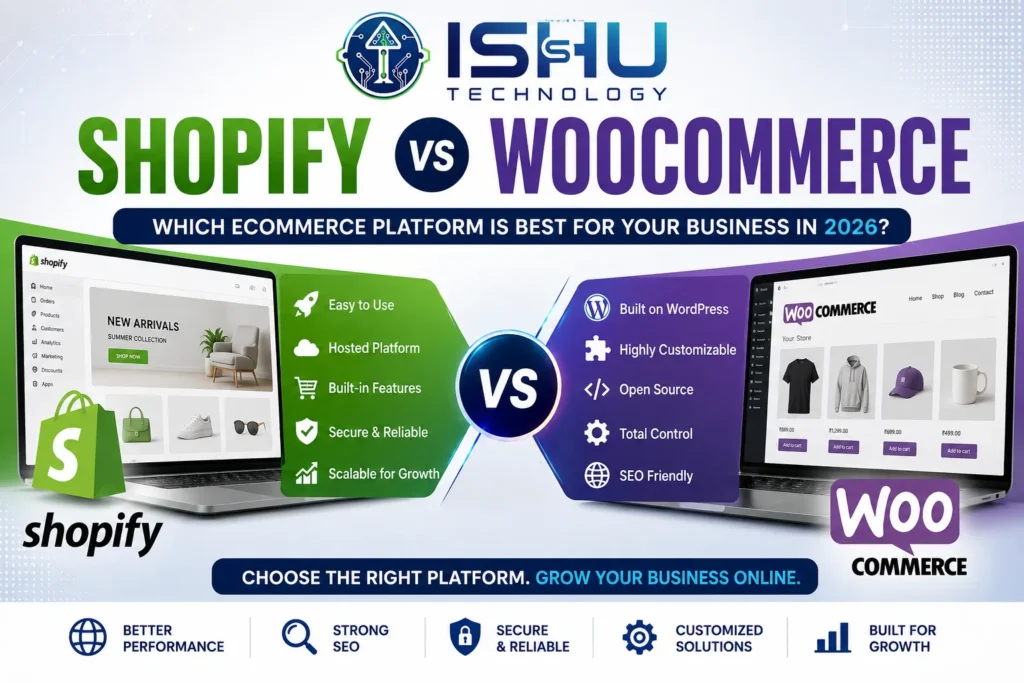
Choosing an ecommerce platform is one of the first major decisions you make when starting or scaling an online store. The platform you choose affects your website’s design, checkout experience, SEO, integrations, maintenance, and long-term growth.
Two of the most popular options businesses consider are Shopify and WooCommerce.
Both can power a successful ecommerce website, but they work in very different ways. Shopify is a hosted ecommerce platform designed to make store management simpler, while WooCommerce is an open-source ecommerce solution built on WordPress that gives businesses more control over their website and technology stack.
So, Shopify vs WooCommerce: which one is better for your business in 2026?
The answer depends on your products, budget, technical requirements, SEO strategy, customization needs, and growth plans.
Shopify vs WooCommerce at a Glance
| Feature | Shopify | WooCommerce |
|---|---|---|
| Platform type | Hosted ecommerce platform | Open-source WordPress ecommerce platform |
| Hosting | Included | Separate hosting required |
| Ease of setup | Easier | Requires more setup |
| Customization | High | Very high |
| SEO flexibility | Good | Excellent |
| Technical maintenance | Lower | Higher |
| Content marketing | Good | Excellent |
| Ecommerce features | Built in | Added through WooCommerce |
| Store ownership | Platform-based | Greater infrastructure control |
| Best suited for | Fast ecommerce launches and D2C brands | Flexible and customized online stores |
Neither platform is automatically better. The right choice is the one that fits the way your business operates.
What Is Shopify?
Shopify is a hosted ecommerce platform that provides the infrastructure needed to create and operate an online store.
Instead of purchasing hosting separately and managing the underlying website environment yourself, Shopify handles much of the technical infrastructure.
You can create product pages, manage inventory, configure payments, customize your storefront, manage orders, and connect your store with various apps and sales channels.
This makes Shopify particularly attractive to businesses that want to focus more on selling and marketing rather than managing website infrastructure.
For a growing D2C brand, for example, Shopify can provide a relatively straightforward way to launch an online store and then add functionality as the business grows.
At Ishu Technology, Shopify development includes custom Shopify and Shopify Plus theme development, payment and shipping setup, third-party integrations, migration, performance optimization, and ongoing store maintenance.
What Is WooCommerce?
WooCommerce is an open-source ecommerce platform designed to work with WordPress.
Instead of being a complete hosted environment like Shopify, WooCommerce gives you an ecommerce framework that runs within your WordPress website.
This approach provides significant flexibility.
You can choose your hosting provider, WordPress theme, plugins, payment gateways, extensions, analytics tools, and custom development solutions.
That flexibility is one of WooCommerce’s biggest strengths.
It can be especially useful for businesses that need a highly customized store or already have a WordPress website with a strong content and SEO strategy.
Ishu Technology provides WooCommerce development and customization, including payment gateway integrations, checkout optimization, and scalable ecommerce solutions.
Shopify vs WooCommerce: Which Is Easier to Use?
For most beginners, Shopify is easier to set up.
The hosting and core ecommerce infrastructure are already managed, so you can concentrate on configuring the store, adding products, selecting a design, and setting up your sales process.
WooCommerce requires more initial setup because you need a WordPress website, hosting, theme, WooCommerce configuration, payment gateway, security setup, and other supporting components.
That does not mean WooCommerce is difficult. It simply gives you more decisions to make.
For a business working with a professional development team, the difference becomes much smaller because the technical setup can be handled for you.
Shopify vs WooCommerce for SEO
SEO is important for ecommerce businesses because organic search can bring customers to product, category, and informational pages without paying for every visit.
Both Shopify and WooCommerce can support an effective ecommerce SEO strategy.
WooCommerce has a particularly strong advantage when your business depends heavily on content marketing. Because it operates within WordPress, you can build detailed blog content, landing pages, category structures, guides, and other content assets alongside your store.
Shopify also provides important ecommerce SEO capabilities, but businesses should still pay attention to technical SEO, site structure, page speed, metadata, product content, internal linking, structured data, and search intent.
The platform alone does not guarantee rankings.
A technically strong Shopify store can outperform a poorly optimized WooCommerce website, and the reverse can also be true.
Which Is Better for Customization?
If maximum customization is your priority, WooCommerce generally gives you more control.
Because WooCommerce is open source and runs on WordPress, developers can customize the store’s code, database, integrations, templates, checkout experience, and functionality.
This can be useful for businesses with unusual product structures or complex workflows.
Shopify is also highly customizable, particularly through custom themes, apps, APIs, and Shopify Plus capabilities. However, you are still operating within Shopify’s platform environment.
For a standard D2C store, Shopify’s customization options are often more than enough.
For a business with complex requirements, WooCommerce may provide the greater level of control.
Shopify vs WooCommerce: Which Is More Cost-Effective?
This is where businesses need to look beyond the initial price.
Shopify uses a subscription-based model, with different plans depending on the features and scale of your business. You may also have additional costs for apps, payment processing, premium themes, and professional development.
WooCommerce itself is open source, but running a WooCommerce store still involves expenses such as hosting, domain registration, premium extensions, development, maintenance, security, and payment processing.
So the question is not simply:
“Which platform is cheaper?”
A better question is:
“Which platform gives my business the best total value for its requirements?”
A small business that wants to launch quickly may find Shopify’s managed environment worth the recurring cost.
A business that needs extensive customization may find WooCommerce more suitable because of the control it provides.
Shopify vs WooCommerce for Small Businesses
For a small business launching its first online store, Shopify can be an attractive option because the technical barrier is relatively low.
For example, suppose you run a fashion brand with 100 products and want to start selling online quickly. You may not need extensive custom development. In that situation, Shopify can provide the ecommerce foundation while your team focuses on product photography, marketing, customer service, and sales.
WooCommerce can be a better fit if your small business already has a WordPress website and wants to add ecommerce without moving to a separate platform.
It can also make sense when you need custom features that are difficult to implement through standard ecommerce tools.
Shopify vs WooCommerce for Large or Growing Businesses
As your business grows, your requirements usually become more complicated.
You may need:
- Custom payment solutions
- ERP or CRM integration
- Advanced inventory management
- Multiple sales channels
- International selling
- Custom shipping rules
- Subscription products
- Advanced analytics
- Marketing automation
- Custom customer journeys
Both Shopify and WooCommerce can support growing ecommerce businesses, but they take different approaches.
Shopify provides a managed ecosystem that can reduce infrastructure management. Shopify Plus can also be considered by businesses with more advanced ecommerce requirements.
WooCommerce gives businesses more control over their infrastructure and integrations, which can be valuable when the store needs extensive customization.
The important thing is to plan for the next stage of growth rather than choosing a platform only for today’s requirements.
Shopify vs WooCommerce for Website Speed
Website speed matters because customers do not want to wait for product pages, carts, or checkout screens to load.
However, platform choice is only one part of website performance.
Theme quality, image sizes, third-party scripts, plugins, apps, hosting, caching, code quality, database optimization, and technical implementation all affect performance.
A heavily customized WooCommerce website with too many plugins can become difficult to maintain.
A Shopify store loaded with unnecessary third-party apps can also suffer from performance issues.
This is why ecommerce development should include performance planning from the beginning.
Ishu Technology’s ecommerce development services focus on high-performance Shopify and WooCommerce stores, including checkout optimization, integrations, and conversion-focused implementation.
Shopify vs WooCommerce for Payment Gateways
Both platforms support multiple payment options, but the exact setup depends on your country, payment provider, business model, and technical requirements.
For Indian ecommerce businesses, payment gateways such as Razorpay can be important. International businesses may also require options such as Stripe or PayPal.
The important thing is to check whether your preferred payment gateway supports your business location and ecommerce requirements before selecting a platform.
A professional ecommerce development team can also help with payment gateway integration, testing, refunds, order status handling, and checkout configuration.
Shopify vs WooCommerce for International Ecommerce
Selling internationally introduces additional requirements.
You may need:
- Multiple currencies
- Multiple languages
- International payment methods
- Regional shipping
- Tax configuration
- Country-specific content
- International SEO
- Localized product information
Shopify provides tools and integrations designed for international commerce.
WooCommerce can also support international stores, but the exact setup depends more heavily on the plugins, extensions, hosting environment, and custom configuration you choose.
If your business plans to sell in India, the USA, the UK, or multiple markets, it is worth planning the international architecture before the store is developed.
Which Platform Is Better for D2C Brands?
For many D2C brands, Shopify is an appealing option because the platform is built around ecommerce.
A D2C company can combine its Shopify store with advertising, email marketing, social media, analytics, inventory, shipping, and other ecommerce tools.
WooCommerce can also work extremely well for D2C businesses, particularly when the brand wants greater control over content, SEO, design, and custom functionality.
The better platform depends on the brand’s operating model.
If speed to market and simple store management are priorities, Shopify may be the better fit.
If customization and control are priorities, WooCommerce deserves serious consideration.
Shopify vs WooCommerce: Which Should You Choose?
Here is a simple way to think about the decision.
Choose Shopify if:
- You want to launch your store quickly.
- You prefer managed hosting and infrastructure.
- Ecommerce is the primary purpose of your website.
- You want less technical maintenance.
- You run a D2C brand and need a scalable ecommerce foundation.
- You prefer an integrated ecommerce ecosystem.
Choose WooCommerce if:
- You already use WordPress.
- SEO and content marketing are major priorities.
- You need extensive customization.
- You want greater control over hosting and website infrastructure.
- Your store requires custom integrations.
- You have developers or an agency to manage the technical side.
Shopify vs WooCommerce: What Should You Choose in 2026?
There is no universal winner in the Shopify vs WooCommerce comparison.
Shopify is a strong choice for businesses that value simplicity, managed infrastructure, and faster ecommerce setup.
WooCommerce is a strong choice for businesses that value flexibility, customization, content, and greater control over their ecommerce website.
The right platform should be selected after considering your products, customers, business model, SEO strategy, budget, integrations, and long-term growth plans.
If you are building a new ecommerce store, migrating an existing website, or planning to scale an online business, Ishu Technology can help you evaluate the technical requirements and build the appropriate solution. The company provides Shopify, Shopify Plus, WooCommerce, WordPress, SEO, Meta Ads, mobile app, and custom CRM development for businesses across India, the USA, and the UK.
A good ecommerce website is not simply about choosing Shopify or WooCommerce. It is about creating a store that is fast, easy to use, search-friendly, secure, and built around the way your customers actually buy.
Frequently Asked Questions
Is Shopify better than WooCommerce?
Shopify is generally easier to launch and maintain, while WooCommerce provides greater control and customization. The better option depends on the business’s requirements.
Is WooCommerce cheaper than Shopify?
WooCommerce’s core platform is open source, but you still need to pay for hosting, development, extensions, security, and maintenance. Shopify has recurring subscription costs. Total cost depends on how the store is built and managed.
Which is better for SEO, Shopify or WooCommerce?
Both can support strong ecommerce SEO. WooCommerce offers extensive content and technical customization through WordPress, while Shopify provides built-in ecommerce functionality and SEO capabilities.
Which platform is better for a new ecommerce business?
Shopify may be a good option if you want a simpler setup and less technical maintenance. WooCommerce may be better if customization and control are more important.
Can I migrate from WooCommerce to Shopify?
Yes. A WooCommerce store can be migrated to Shopify, but the process should include product and customer data migration, URL mapping, redirects, metadata review, and SEO checks to minimize disruption.
Can I migrate from Shopify to WooCommerce?
Yes. Shopify stores can also be migrated to WooCommerce. The migration should be planned carefully to preserve product information, URLs, customer data where applicable, and organic search visibility.
Does Ishu Technology provide Shopify and WooCommerce development?
Yes. Ishu Technology provides custom Shopify, Shopify Plus, and WooCommerce development, including ecommerce customization, integrations, payment gateway setup, performance optimization, and related digital services.