AI Search vs Google Search in 2026: What Businesses Need to Do to Get Found

Search is no longer limited to typing a few words into Google and opening the first website that appears.
People now ask longer questions, compare different options, use voice or images, and expect a useful answer quickly. Google has also changed the way Search works by adding AI Overviews and AI Mode. As of August 2026, Google says AI Overviews have more than 2.5 billion monthly active users, while AI Mode has crossed one billion monthly users globally.
For businesses, this raises an important question:
If customers are using AI-powered search, how can a business website continue to get found?
The answer is not to forget traditional SEO. Instead, businesses need to understand how AI Search vs Google Search works and build content that can serve both.
AI Search vs Google Search: What’s the Difference?
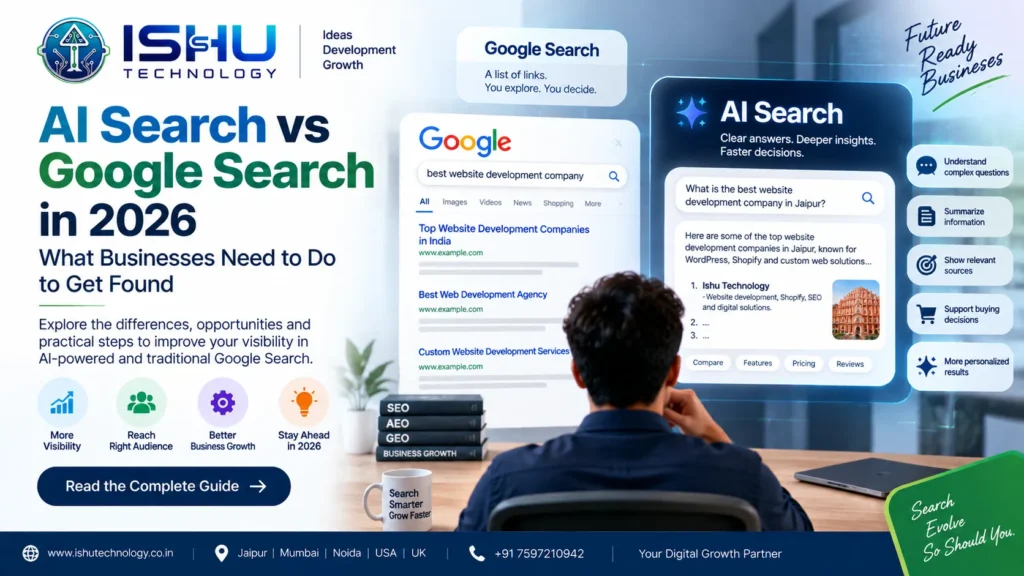
Traditional Google Search usually works like a directory. You enter a query, Google shows relevant results, and you choose which pages to visit.
For example, someone searching for “Shopify website development company in Jaipur” may see service pages, agency websites, directories and articles.
AI Search changes the experience. Instead of only displaying a list of pages, AI-powered features can understand a more detailed question and provide a summarized response with links to relevant sources.For example, a user could ask: “What should I check before hiring a Shopify development company for my ecommerce business?” The search experience can help organize information around the question instead of making the user open several pages just to understand the basics. Google says AI Mode is designed for complex questions and follow-up conversations. Its Search systems can break a question into related searches to explore different parts of a topic.That creates a new opportunity for businesses with useful, well-structured websites.
Does SEO Still Matter in AI Search?
Yes, SEO still matters.
This is one of the biggest misunderstandings around AI Search. Businesses sometimes assume that traditional SEO will disappear because AI can generate answers. However, Google continues to connect its AI Search experiences with content from the web. Google’s own guidance says website owners should continue following established SEO best practices for AI features in Search. There is no separate technical requirement that guarantees inclusion in AI Overviews or AI Mode. So, instead of replacing SEO, AI Search adds another reason to get the basics right.
A business website should still have:
- Useful and original content
- Clear page structure
- Strong internal linking
- Good technical SEO
- Mobile-friendly pages
- Fast loading times
- Relevant keywords and topics
- Accurate business information
- Helpful product or service details
- Proper structured data where appropriate
The goal is simple: make your website easy for people to use and easy for search systems to understand.
What Is AI Search Optimization?
AI search optimization means preparing your website and content so that it can be understood and discovered through AI-powered search experiences. It is not about adding the word “AI” to every page. Instead, think about the questions your customers actually ask. Suppose you run a web development company. A basic service page might say:
“We provide WordPress development services.”
That is useful, but limited.
A stronger page could explain:
- What WordPress development includes
- When a custom WordPress website makes sense
- How much WordPress development can cost
- What affects development time
- How SEO is handled
- How website speed is improved
- What happens after launch
- Which businesses can benefit from the service
Now the page gives visitors much more context.
It also creates a stronger content resource around the main topic.
AEO, GEO and SEO: How Do They Work Together?
You will often see three terms in discussions about modern search:
SEO: Search Engine Optimization
AEO: Answer Engine Optimization
GEO: Generative Engine Optimization
They are related, but they are not simply three separate replacements for SEO.
SEO focuses on helping search engines discover, understand and rank relevant pages.
AEO focuses more on answering specific questions clearly.
GEO is commonly used for strategies aimed at visibility in generative AI and AI-powered answer experiences.
For a business, the practical approach is to combine these ideas rather than treating them as completely separate marketing systems.
For example, an article targeting “Shopify website development cost in India” can include pricing factors, development scope, platform costs, FAQs and practical examples.
That gives a user a complete answer instead of forcing them to search five different questions.
How Can a Business Improve Its AI Search Visibility?
There is no guaranteed method for making a website appear in an AI-generated answer. Google itself warns that following best practices does not guarantee that a page will be crawled, indexed or displayed in a particular Search feature. Still, businesses can improve the quality and accessibility of their content.
Answer Real Customer Questions
Start with questions customers already ask your sales team. For a digital agency, these could include:
- How much does a website cost?
- Shopify or WooCommerce, which should I choose?
- How long does website development take?
- Can I migrate my existing store?
- How can I improve website speed?
- Does SEO start during website development?
These questions can become useful sections within service pages or detailed blog posts.
Give Specific Information
Generic statements do not tell customers much. Instead of saying:
“We build high-quality websites.”
Explain what that actually means. Talk about website structure, responsive design, integrations, performance, security, SEO, maintenance and the type of business the service is designed for. Specific information helps users make decisions.
Keep Important Information in Text
Google’s AI Search guidance emphasizes making important content available in formats that Search can access and understand. Businesses should not hide essential information only inside images, videos or interactive elements. For example, if your service includes five important features, list them clearly on the page. Do not make the visitor guess what you offer.
Local SEO Still Matters
AI Search does not make local search irrelevant. In fact, local businesses have another reason to keep their information accurate. If your company serves Jaipur, your website should clearly communicate that. Mention relevant services, service areas, contact details and business information naturally. For example, Ishu Technology can clearly explain its website development, Shopify, WordPress, SEO and other services while providing relevant location information for customers looking for a digital agency in Jaipur. The same principle applies if a business serves Mumbai, Noida, other Indian cities, or international markets. The information should be useful rather than simply repeating a city name throughout the page.
AI Search and Ecommerce Websites
The change is also important for ecommerce businesses. Customers may use AI-powered search to research products, compare features and understand which option fits their needs. That makes product information more important than ever. A strong ecommerce product page should clearly explain:
- Product name
- Features
- Size or specifications
- Material
- Price
- Availability
- Shipping information
- Return policy
- Product images
- Frequently asked questions
For Shopify and WooCommerce stores, clean product data and well-organized product pages can make the shopping experience easier for both customers and search systems. Google is also continuing to develop AI-powered shopping experiences, making structured and useful product information increasingly relevant to ecommerce businesses.
Your Website Content Should Be Written for People First
One mistake businesses should avoid is trying to write specifically for AI systems. That can lead to awkward content filled with repeated keywords and vague statements. Instead, write the way you would explain your service to a real customer. Use simple language. Answer the question early. Give examples when they help. Explain technical terms instead of assuming everyone understands them. And most importantly, do not publish content just because a keyword has search volume.vPublish it because it solves a real problem. Google continues to emphasize useful, people-first content as part of its Search guidance.
How Ishu Technology Can Help
At Ishu Technology, our focus is on building websites and digital solutions that support real business goals. Our services include WordPress development, Shopify development, WooCommerce development, SEO, Meta Ads, mobile app development, custom CRM development and AI-powered business solutions. For a business preparing for AI Search, the first step is not adding unnecessary AI features. The foundation comes first. That means creating a technically sound website, organizing information properly, developing useful content, improving performance and making important business information easy to understand.
Once those foundations are in place, businesses can work on broader SEO, AEO and GEO strategies to improve their visibility across changing search experiences.
How Do You Measure AI Search Performance?
Search visibility should be measured with real data instead of assumptions. Google introduced a dedicated Generative AI performance report in Search Console in 2026. The report provides information about how websites appear in generative AI features such as AI Overviews and AI Mode. Google says these insights became available globally by August 31, 2026. Businesses can use this information alongside normal SEO data such as:
- Organic impressions
- Clicks
- Click-through rate
- Search queries
- Landing pages
- Leads
- Sales
- Conversions
- User engagement
This gives a much clearer picture of whether search visibility is actually helping the business.
What Should Businesses Do Now?
You do not need to completely change your SEO strategy because AI Search is growing . Instead, improve the fundamentals. Create useful pages. Answer customer questions. Keep your website technically healthy. Make important information easy to find. Improve your local or ecommerce information where relevant. Then use Search Console and analytics to see what people are actually finding and clicking. The relationship between AI Search vs Google Search is not simply about one replacing the other. Google is adding AI capabilities to Search while continuing to connect users with information from websites across the web. For businesses, the practical lesson is straightforward:
Build a website that is useful enough for people to trust and clear enough for search systems to understand.
That approach can help your business stay prepared as search continues to evolve through 2026 and beyond.
Frequently Asked Questions
Is AI Search replacing Google Search?
No. Google is adding AI features such as AI Overviews and AI Mode within its Search experience. These features continue to connect users with web content and links.
Is SEO still important in 2026?
Yes. Google continues to recommend established SEO practices for websites appearing in its AI Search features.
What is GEO in SEO?
GEO usually means Generative Engine Optimization. The term is used for strategies focused on improving visibility in generative AI search and answer experiences.
How can I make my website ready for AI Search?
Start with technical SEO, useful original content, clear headings, strong internal links, accurate business information and pages that directly answer customer questions.
Can small businesses benefit from AI Search?
Yes. Small businesses can create detailed service pages, local content, FAQs and helpful guides that clearly explain what they offer and who they serve.
Does AI Search mean keywords are no longer useful?
No. Keywords still help businesses understand what people are searching for. However, content should cover the underlying topic naturally instead of repeating the same keyword unnecessarily