Introduction
Businesses are using AI in more practical ways than ever before. Instead of using AI only to generate text or answer simple questions, companies can now use AI agents to handle specific tasks, understand requests, and help move business processes forward.
This is where an AI agent for your business can become useful.
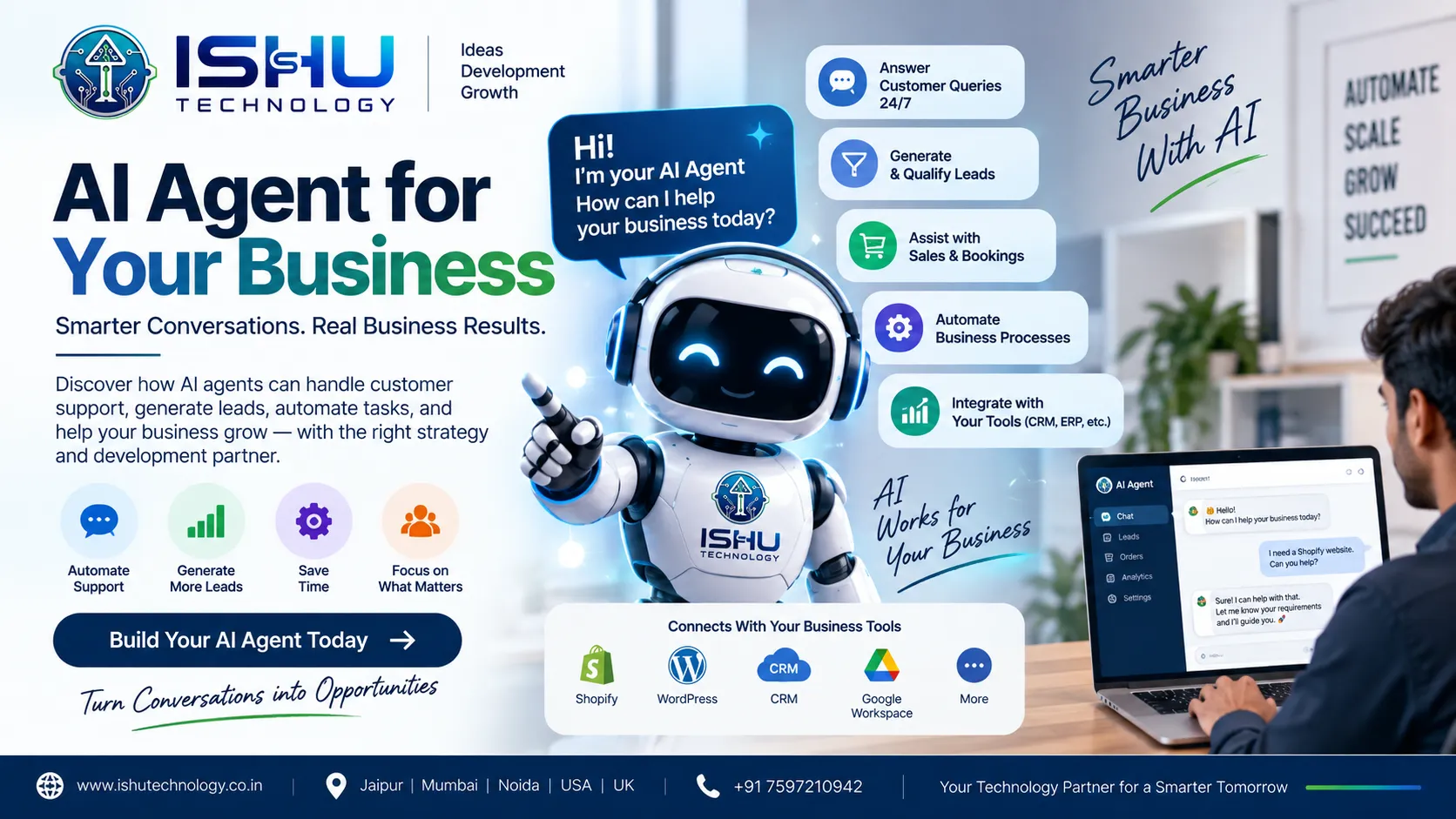
An AI agent can interact with customers, answer questions, collect information, assist with lead generation, support internal teams, and connect with business tools. The exact role depends on how the agent is designed and what systems it can access.
For example, a customer may ask about a product, delivery time, service price, or appointment. An AI agent can understand the request and provide a relevant response. If the task requires a human, the conversation can then be passed to the appropriate team.
At Ishu Technology, we work with modern web, ecommerce, AI, CRM, and automation solutions. The company has also developed its own AI Agent Chatbot, reflecting a practical approach to using AI for business communication and digital workflows.
This guide explains what is an AI agent, how an AI agent works, where businesses can use one, and what to consider before developing an AI agent for your business.
What Is an AI Agent?
So, what is an AI agent?
An AI agent is a software system that can understand a user’s request, process information, and take an appropriate action based on its instructions and available tools.
A traditional chatbot may mainly respond to predefined questions.
An AI agent can go further.
For example, imagine a customer says:
“I want to know which product is suitable for me and how quickly it can be delivered.”
An AI agent can understand the request, look at available information, provide suitable options, and explain the next step.
The exact capabilities depend on the system, its data, its tools, and the permissions given to it.
In simple terms:
Traditional chatbot → answers questions
AI agent → understands a task and can help complete it
This difference makes AI agents interesting for businesses that want to automate parts of their customer and internal workflows.
What Is an AI Agent in AI?
If you are searching for what is an AI agent in AI, the simplest explanation is this:
An AI agent is an AI-powered software system designed to work toward a specific goal.
It can receive information, understand the context, make decisions within its defined rules, and use available tools to complete a task.
For example, a business AI agent might be instructed to:
- Understand a customer question.
- Identify what the customer needs.
- Search the approved business information.
- Provide an answer.
- Collect lead details when appropriate.
- Send the information to a CRM.
- Escalate the conversation to a human when required.
Not every AI agent has all of these capabilities.
The system should be designed around the actual business requirement.
Why Use an AI Agent for Your Business?
The biggest reason to use an AI agent is not simply “because AI is trending.”
The real value comes from solving repetitive business tasks.
For example, customer support teams often answer similar questions every day.
Customers may ask:
- What are your prices?
- What services do you offer?
- Where are you located?
- How long does delivery take?
- What is your return policy?
- How can I book a service?
- Can I speak with someone?
- Which product should I choose?
An AI agent can handle suitable questions and provide information quickly.
As a result, your team can spend more time on conversations that need human attention.
AI Agent vs Traditional Chatbot
These terms are often used interchangeably, but they can describe different levels of functionality.
| Traditional Chatbot | AI Agent |
|---|---|
| Handles common questions | Can handle broader tasks |
| Often follows fixed flows | Can understand context |
| Limited decision-making | Can make decisions within defined rules |
| Usually provides information | Can potentially take actions |
| Limited integrations | Can connect with business tools |
| Best for simple conversations | Useful for more complex workflows |
However, an AI agent is not automatically better for every situation.
If your business only needs a simple FAQ chatbot, a traditional chatbot may be enough.
On the other hand, an AI agent can make more sense when you need conversation, information retrieval, automation, and integrations in one workflow.
How Can an AI Agent Help Your Business?
There are many possible use cases.
The right one depends on your business model.
1. Customer Support
Customer support is one of the most obvious applications.
An AI agent can answer common questions about:
- Products
- Services
- Pricing
- Orders
- Delivery
- Returns
- Business hours
- Policies
For instance, an ecommerce customer may ask about an order or product.
The AI agent can provide information from approved business data or guide the customer to the right support channel.
2. Lead Generation
An AI agent can also help businesses collect leads.
Instead of displaying only a “Contact Us” form, the website can have a conversational experience.
For example:
Customer: “I need a Shopify website.”
AI Agent: “Sure. What type of products do you sell?”
The agent can then ask relevant questions about:
- Business type
- Required services
- Budget range
- Project requirements
- Contact information
The collected information can then be passed to the sales team, depending on the integration.
Therefore, the website becomes more interactive while the sales team receives better context.
3. Sales Assistance
An AI agent can help customers during the buying process.
For example, a fashion store could use an agent to help customers find products based on:
- Size
- Colour
- Budget
- Style
- Occasion
- Product type
Similarly, a technology company could use an AI agent to explain services and help visitors identify which service may fit their requirements.
The agent does not need to replace a salesperson.
Instead, it can assist customers until a human conversation becomes necessary.
4. Appointment and Booking Assistance
Service businesses can also use AI agents for appointment-related conversations.
For example, a customer might ask:
“Can I book a consultation this week?”
Depending on the system’s integrations and permissions, an AI agent could collect the required details and guide the customer through the booking process.
This can reduce repetitive back-and-forth communication.
5. Ecommerce Assistance
Ecommerce businesses can use AI agents throughout the shopping journey.
A customer may ask:
“Show me summer dresses under ₹2,500.”
The agent could help narrow down the available products if it has access to the store catalogue.
It can also answer questions about:
- Product specifications
- Sizes
- Colours
- Availability
- Shipping
- Returns
- Related products
For a large ecommerce store, this type of assistance can make product discovery easier.
6. Internal Business Support
AI agents do not have to face customers.
They can also support internal teams.
For example, an internal AI agent could help employees find information from approved company documents, policies, processes, or knowledge bases.
A sales employee might ask:
“What is our process for handling this type of lead?”
The agent can provide the relevant information if that content has been made available to it.
This can make internal information easier to access.
AI Agents and CRM Integration
CRM integration can make an AI agent more useful for sales and support teams.
For example, when a visitor interacts with an AI agent, the system may collect information such as:
- Name
- Phone number
- Business type
- Service requirement
- Conversation details
With the right integration, this information can be sent to a CRM.
The sales team can then follow up with better context.
However, businesses should carefully control what information the AI agent can access and store.
Data permissions, security, and privacy should be considered during development.
AI Agent for Ecommerce Businesses
Ecommerce is one area where AI agents can support several parts of the customer journey.
A customer may start with a broad question.
“I need a gift for someone who likes fresh fragrances.”
The AI agent can ask follow-up questions and guide the customer toward relevant products, provided it has access to suitable product information.
The same approach can work for fashion.
For example:
“I need an ethnic outfit for a wedding under ₹3,000.”
The agent can help narrow the search based on available products and information.
As a result, customers may spend less time searching manually.
AI Agent for Your Website
Your website can become the main place where customers interact with your AI agent.
A website-based AI agent can appear through a chat interface.
Visitors can ask questions without navigating through several pages.
For example, a digital agency website could allow visitors to ask:
- Do you develop Shopify websites?
- Do you provide SEO services?
- How much does a website cost?
- Do you build WooCommerce stores?
- Can you develop a custom CRM?
- Do you develop mobile apps?
The agent can provide answers based on the business information it has been given.
This creates a more conversational website experience.
How an AI Agent Works
Although the technology behind AI agents can be complex, the basic process is easier to understand.
Step 1: User Sends a Request
A customer or employee asks a question or gives an instruction.
Step 2: AI Understands the Request
The system processes the language and identifies what the user is trying to achieve.
Step 3: Relevant Information Is Retrieved
The agent can use approved information, documents, databases, or connected systems depending on its setup.
Step 4: The Agent Decides What to Do
Based on its instructions and available tools, the agent determines the appropriate next step.
Step 5: Action or Response
The agent provides an answer or performs an allowed action.
Step 6: Human Escalation When Needed
If the request is outside the agent’s scope, the conversation can be transferred to a human team member. This final step is important. AI should not be forced to handle every situation.
What Does an AI Agent Need to Work Properly?
An AI agent needs more than an AI model. A useful business agent may require:
- Clear instructions
- Business knowledge
- Product or service data
- Knowledge base
- APIs
- CRM integration
- Ecommerce integration
- Authentication
- Security controls
- Conversation history
- Monitoring
- Human escalation
Therefore, AI agent development is not simply about adding a chat window to a website. The system needs to be designed around the business process.
How to Build an AI Agent for Your Business
If you are planning to develop an AI agent, start with the problem.
Do not begin by asking:
“What can AI do?”
Instead, ask:
“Which business task should AI help us solve?”
A practical development process can look like this.
1. Define the Goal
Decide what the AI agent should do.
For example:
Customer support
or
Lead qualification
or
Product recommendations
or
Internal employee assistance
A clear goal makes development easier.
2. Define What the Agent Can and Cannot Do
Set clear boundaries. For example, an AI agent may answer product questions but send refund requests to a human. This helps reduce incorrect actions.
3. Prepare Business Information
The agent needs accurate information.
This may include:
- Services
- Products
- FAQs
- Pricing
- Policies
- Contact information
- Documentation
- Internal knowledge
Information should also be reviewed regularly. Outdated information can lead to poor answers.
4. Connect Required Tools
Depending on the project, the agent may need access to:
- CRM
- Ecommerce platform
- Calendar
- Database
- Helpdesk
- Inventory system
- Internal documents
- APIs
Only give the agent the access it actually needs.
5. Test Real Conversations
Before launch, test different types of questions.
Include:
- Simple questions
- Complex questions
- Unexpected questions
- Incorrect information
- Requests outside the agent’s scope
This helps identify gaps before customers interact with the system.
Security and Privacy Matter
An AI agent may interact with customer information or business systems. Therefore, security should be part of the development process. Important considerations include:
- Access control
- Data permissions
- Authentication
- Secure APIs
- Logging
- Data retention
- Human approval for sensitive actions
The AI agent should only have access to the information and tools required for its job. This principle becomes even more important when an agent is connected to CRM, ecommerce, payment, or internal business systems.
AEO and GEO for AI Agent Content
If your business wants customers to discover its services through search and AI-powered experiences, your website content should provide clear answers.
For example, a service page should clearly explain:
What does the business offer?
Who is the service for?
How does the service work?
What problems does it solve?
What technologies are used?
How can someone get started?
This type of clear information can also make content easier to understand across search engines and AI-powered discovery systems. For local businesses, relevant geographic information can also be included where appropriate.
For example:
AI agent development company in Jaipur
AI agent development company in India
AI chatbot development company for businesses
However, location content should be genuinely useful rather than created only to repeat city names.
AI Agent vs AI Chatbot: Which One Does Your Business Need?
The answer depends on your goal. If you only want to answer common questions, a chatbot may be enough. If you want customers to interact with information, complete tasks, use connected tools, or move through a business workflow, an AI agent may be more suitable.
For example:
| Requirement | Suitable Approach |
|---|---|
| FAQ answers | Chatbot |
| Basic customer support | Chatbot or AI assistant |
| Lead qualification | AI agent |
| Product recommendations | AI agent |
| CRM actions | AI agent |
| Multi-step workflows | AI agent |
| Internal knowledge search | AI assistant/agent |
| Complex automation | AI agent |
The technology should follow the business requirement.
Ishu Technology’s AI Agent Approach
Ishu Technology works across website development, ecommerce, SEO, mobile applications, custom CRM development, and digital solutions. The company has also developed its own AI Agent Chatbot. This reflects a practical use of AI for areas such as customer communication, business enquiries, and digital workflows. For businesses considering an AI agent, Ishu Technology can approach the project around the actual use case rather than simply adding AI as a website feature.
A project may involve:
- AI agent planning
- Conversational interface
- Business knowledge integration
- Website integration
- CRM integration
- Ecommerce integration
- API connections
- Workflow automation
- Human handoff
- Testing
- Ongoing improvements
The exact features depend on the business requirements and the systems that need to be connected.
Benefits of an AI Agent for Your Business
A properly designed AI agent can provide several practical benefits.
Faster Responses
Customers can receive answers without always waiting for a team member.
24/7 Availability
A website-based AI agent can remain available outside normal business hours.
Lead Qualification
The agent can collect useful information before a salesperson follows up.
Better Product Discovery
Ecommerce customers can receive conversational help while searching for products.
Reduced Repetitive Work
Teams can spend less time answering the same basic questions.
Scalable Customer Communication
An AI agent can handle multiple conversations without requiring one employee for every basic query. However, results depend on the quality of the implementation, business data, integrations, and the tasks assigned to the agent.
Is an AI Agent Worth It for a Small Business?
It can be, but not every small business needs one. A simple website with a few pages may not need a sophisticated AI agent. On the other hand, an AI agent can make sense when a business receives many repeated enquiries or has a clear workflow that can be partially automated. For example, an ecommerce store with a large product catalogue may benefit from an AI shopping assistant. Similarly, a service company receiving many enquiries may use an AI agent to collect project details before sending leads to the sales team.
Therefore, the right question is not:
“Should every business use an AI agent?”
Instead, ask:
“Is there a repetitive business problem that an AI agent can solve effectively?”
Frequently Asked Questions
What is an AI agent?
An AI agent is an AI-powered software system that can understand requests, process information, and take actions within its defined instructions and available tools.
What is an AI agent in AI?
An AI agent is a system designed to work toward a specific goal. It can understand input, use relevant information, make decisions within defined limits, and perform permitted actions.
What is an AI agent for your business?
An AI agent for your business is designed around a specific business need, such as customer support, lead generation, product recommendations, internal knowledge, or workflow automation.
What is the difference between an AI agent and a chatbot?
A basic chatbot usually focuses on answering questions or following predefined conversation flows. An AI agent can be designed to handle more complex tasks and interact with connected business systems.
Can an AI agent generate leads?
Yes. An AI agent can ask qualifying questions, collect contact information, understand requirements, and pass suitable information to a sales team when the required integrations are available.
Can an AI agent work with a CRM?
Yes. An AI agent can be integrated with a CRM through APIs or other supported methods. The integration should use appropriate security and access controls.
Can an AI agent be used for ecommerce?
Yes. An ecommerce AI agent can help with product discovery, product questions, recommendations, order-related information, and other customer support tasks, depending on its integrations.
Does every business need an AI agent?
No. The need depends on the business problem. A simple chatbot may be enough for basic FAQs, while businesses with more complex workflows may benefit from an AI agent.
Can Ishu Technology develop an AI agent for a business?
Ishu Technology works with AI, web development, ecommerce, and custom business solutions. The company has also developed its own AI Agent Chatbot. AI agent development can be planned around the specific business use case, integrations, and workflow requirements.
Final Thoughts
An AI agent for your business should not be treated as just another website feature. Its real value comes from solving a specific problem. That could mean answering customer questions, qualifying leads, helping shoppers find products, supporting employees, or connecting different business systems. The best place to start is with a clear workflow. Identify the repetitive task, define what the AI agent should handle, prepare accurate business information, connect the necessary tools, and test the system before launch. For businesses exploring AI agent development, AI chatbot development, ecommerce solutions, custom CRM integration, or website development, Ishu Technology can build the technology around the actual business requirement. AI agents are becoming more useful because they can move beyond simple answers and support real workflows. The opportunity for businesses is not to use AI everywhere, but to use it where it can provide meaningful help.